

Worship Is Divinely Creative
Content
The tremendous spiritual power of worship is often underestimated. Worship rejuvenates, revitalizes, and regenerates—it literally transforms us in every way. It is by far the best way to draw on the spiritual energies and divine forces in us and all around us.
On the highest spiritual level, intelligent worship is a loving reverence for a perfect Divine Being, the Source of all reality. It is a simple but humble act of adoration and praise. It is a heartfelt love and affectionate veneration for the Infinite and Eternal Source and all that it represents.
Whatever we adore, idolize, or worship is what we become. When my daughter was young, she idolized a female pop star. She dressed like her, acted like her, and even tried to sing like her. In the process, she was recreating herself; she was becoming the very thing she worshiped.
A spiritual transformation is no different in principle. When we idolize the beauty, goodness, and truth of a divine Creator, we become beautiful, good, and true ourselves. When we love, adore, and revere spiritual ideals, we eventually become those ideals. In every sense, worship is divinely creative.
Worship changes the worshiper into the image of One worshiped.
– Jack W. Hayford
By venerating the ideals of divinity, we identify with these ideals. This is the psychological process that makes them a reality in our lives.
Upgrade Your Image of God
Over the ages, people have worshiped almost anything you can imagine—stones, mountains, trees, animals, the sun, the stars, and even other people. Nature worship is one of the earliest expressions of devotion, which is not surprising, considering that early humans, immersed in their natural surroundings, relied heavily on wild animals and plants. And at the time, natural events, such as earthquakes, volcanoes, thunder, and lightning, were inexplicable. Even in the modern era, many afflictions and natural catastrophes are still attributed to acts of God.
But nature is not God, and natural disasters are not a form of divine retribution. All things in nature, like all things in the universe, are either products or by-products of the original acts of creation.
Worship, in its highest expression, focuses on the Source of all reality, not the manifestations of it. Nevertheless, the beauty of nature can truly inspire us to worship the divine Source.
Perfection is in nature, but nature is not perfect.
– The Urantia Book
Intelligent worship is most effective and truly transforming when we have a clearer picture of God’s true nature. Achieving this requires a clear concept of what divine nature means, at least as much as is humanly possible.
This doesn’t require us to envision God in any form, like an old man in the sky, but instead to imagine God’s personal nature and the ideals of divinity. These might appear to be intangible realities, but they are in fact spiritual realities, and they give us something tangible to attain—positive spiritual thoughts.
We begin the process by drawing on our creative imaginations, because it’s difficult to adore or worship something you cannot imagine or conceive.
See Creative Imagination as a Spiritual Technique
Here are a few concepts of the personal nature of God:
- God is the First Personality.
- God is love and the source of all love.
- God is truth and the divine source of all truth.
- God is beautiful and the divine source of all beauty.
- God is good and the ultimate source of all goodness.
- God is your friend.
Also see God-Consciousness and Essential Concepts of God
What you are attempting to do is to discover some truth about the nature of God and then to align yourself with this truth by becoming more like God in your thoughts and deeds.
Being perfect like God may seem like a distant goal, but think of it as the spiritual ideal that beckons you forward. How much truth you realize and absorb depends on your willingness and readiness to receive God’s wisdom, and it also depends on your wholehearted conviction that a loving God can and will reveal truth to you.
No matter how much success you have in visualizing a perfect God, keep in mind that there actually does exist a true, infinite, eternal, and loving Universal Spirit beyond anything you can imagine. Your job is simply to know this God to the best of your ability.
Worship Links You to God
In the God experience, worship is the act of linking your superconscious mind with the Spirit of God within you. Your adoration of God is a state of mind that allows you to make a loving connection with the very Source of Light and Life, a connection that harmonizes your thoughts, feelings, and emotions with the divine nature. It is indeed the most powerful technique available to you for your spiritual transformation.
Prayer is spiritually sustaining, but worship is divinely creative.
– The Urantia Book
While prayer nourishes the soul and sustains us spiritually, worship is a divinely creative manna that literally recreates us. It is the psychological practice of uniting with God in a dynamic way, making us more like the divinity we adore.
See Prayer – The Breath of Spirit Life
A worship experience is simple and effortless. It occurs any time we contemplate and venerate the attributes and nature of God, or when we ponder and aspire to divine ideals and values. It is a devotional exercise always enhanced by imagining ourselves in the immediate presence of God, all the while having complete faith and trust in divine wisdom and goodness.
Sharing your inner life with God is the beginning of your intimate relationship with the divine Presence. And we cultivate this worshipful state of mind by attempting to feel the presence and love of God. In this state, we contemplate the infinity and eternity of God, we stand in awe of the magnificence, brilliance, and glory of this majestic Spirit—the loving Source of all things.
Worship is a personal communion with that which is divinely real, with that which is the very source of reality.
– The Urantia Book
Worship Is Self-Less but Beneficial
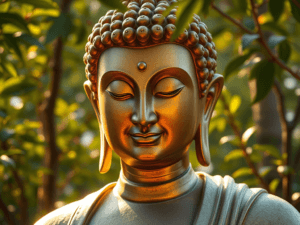
In Zen meditation, practitioners not only admire the qualities of Buddhahood, but they also attempt to forget themselves in order to merge with universe consciousness, or the wisdom of Tao. This is a meaningful objective similar to that of the God experience, in which worship is the act of forgetting ourselves so that we may become unified with the First Source.
Worship is the act of a part identifying itself with the Whole; the finite with the Infinite.
– The Urantia Book
Indeed, genuine worship is completely selfless. Unlike prayer, it asks for nothing and expects nothing in return. We get ourselves completely out of the way. It is our act of selfless adoration, an attitude of mind in which we look up to and revere the perfection of God in all ways and all things.
Nonetheless, while an attitude of true worship is selfless, it has many rewards for the worshiper. Apart from transforming our spiritual natures, it’s a source of relaxation, dissolves anxieties, eliminates mental conflicts, enhances our powers of reflection, and gives us the ability to perceive ever-deepening meanings and values. Intelligent worship fosters wisdom and courage, augments spiritual insight, and inspires the soul.
Through worship, we approach divine realities and begin to see things from a spiritual and cosmic perspective. This, in turn, fosters greater wisdom, leading to increased self-realization, cosmic consciousness, and God consciousness.
Our love for the divine is then reflected in our own lives through loving service and unselfish devotion to others. These are the acts of a spirit-born soul wholeheartedly dedicated to the love of God.
We worship God first because he is, then because he is in us, and last because we are in him.
– The Urantia Book
There is no need to worry about how we should worship or what we should say. There is no correct way to worship. More so, it’s an attitude of mind—humble admiration and complete trust in a perfect God—rather than a string of words. It arises spontaneously from our hearts and souls. All we need to do is consciously allow the Paradise Spirit to conduct worship on our behalf. It is effortless adoration.
We could begin by imagining and admiring the truth, beauty, and love of God, and then move on to a reverence for the goodness of God. We could also give thanks to the spiritual forces in us and all around us. Throughout it all, we have faith that, by yielding to these good powers, we cannot fail—nothing can stop us. All we have to do is try.
Worship, taught Jesus, makes one increasingly like the being who is worshiped.
The Urantia Book