
Who Are You?
Content
What is it that makes us human? And why are we so different from the rest of the animal kingdom? In other posts, we explored the nature of the mental self—the mind—and ways to take control of our thoughts. We also probed the nature of the spiritual self—the soul—and ways to improve soul growth. But in this post, we explore the true self—that part of us that has the power to decide. This is the personality, the same entity that makes that momentous decision to follow the Spirit Within.
Personality and ego are synonymous. The word ego is simply the Latin word for self. It was popularized in 20th-century psychology by the Austrian neurologist, Sigmund Freud, who used it to refer to the conscious activities of the brain, as opposed to the unconscious activities of the id (instinctual brain) and the superego (moral brain).
Having an ego does not necessarily imply we are egotistical, which is having an exaggerated sense of self-importance. Nor does ego imply that we believe in the doctrine of egoism, a cynical philosophy that claims the chief motivation for all conscious action is individual self-interest.
Is the Ego an Illusion?
There is a continuing trend in New Age spiritual teachings and even in modern psychology that the ego, or self, is a figment of the imagination. Thus, any notion of self is either an illusion or a delusion. Such notions have deep roots in Buddhism, giving rise to psychological theories postulating that all conceptions of self—the way we perceive ourselves—are constructed realities. They are narratives about ourselves that we have come to accept as real.
There is some truth to this. But whether our ideas about ourselves are self-constructed or socially constructed, the self is real. When contemplating the self, we must be careful not to confuse or conflate the manifestations of mind (thoughts, feelings, emotions) with the true self—the personality that is you.
No doubt, our concepts about ourselves are constructed; nonetheless, it is the self that constructs the narrative about the self, and it is the self that accepts its own self-created constructs. Anything that can be known or seen can only be known or seen by the self. And any notion of enlightenment can only be to enlighten the self.
The true delusion is not the self, but rather the belief that the self is a thing independent of, or existing apart from, the rest of the universe. This misguided sentiment is reinforced by illusions of selfishness and delusions of self-importance.
Any belief in a truly independent self is a delusion because no one in this world is entirely independent; we all rely on society and the world at large for our existence. Whenever someone claims to have “made it on their own,” they are ignoring the obvious—that they would have had no success if not for a country’s already established infrastructure, a free economy, dedicated employees, and all the individuals who bought into their ideas or products (McQuaig & Brooks 2010).
However, the self, while not entirely independent, is a separate reality, a spiritual reality. The grand illusion is self-importance, a self-centered frame of mind that cultivates a self-serving lifestyle, one that inevitably results in self-isolation.
Whenever we live a self-centered life, we separate ourselves from other selves and distance ourselves from the reality of all personal relationships. Whenever we entertain narcissistic notions of self-glorification or superiority, we increase the risk of becoming lonely, confused, and despairing. Pride in oneself is good in moderation, but it can be self-destructive when taken too far, especially if it negates the value of others.
Our spiritual aim is not to eradicate the ego (which is impossible anyway) but rather to integrate the self with the reality of the universe, as the Chinese philosopher Lao Tzu advised. It is coming to realize who we are as well as where and how we fit in God’s universe. In other words, it is understanding our true nature and our true relationships to others, both human and divine, within the existing cosmos.
For more on Lao Tzu, see Cosmic Unity
We are all interconnected in a cosmic system in which the parts depend on the whole and the whole relies on the parts. But despite our interdependence, we cannot deny our individual uniqueness and our powers of free will. If anything, we should celebrate the personal and unique contributions that our selves have to offer the whole, while being mindful that any vain clamoring for selfish recognition is unrealistic in a God-centered universe.
God-consciousness is equivalent to the integration of the self with the universe, and on the highest levels of spiritual reality.
– The Urantia Book
Personality and You
As we ponder our individual selves and our inescapable relationship to the whole, the inquisitive mind must wonder—what exactly is the self? And what do we mean by personality?
In psychology, personality is commonly defined as a characteristic way of thinking, feeling, and behaving—those distinctive aspects we usually associate with a person’s character or character traits. However, there is no generally agreed-upon definition of personality, even within psychology.
Early studies proposed that personality is a unity of individual mental traits—a psyche. Sigmund Freud proposed his personality theory in 1923, which divided the human psyche into the three parts already mentioned—id, ego, and superego.
In his theoretical model, the ego is the mediator or unifier between the id (animal instincts) and the superego (moral direction). It is the conscious self operating in the tension between the id (subconscious self) and the superego (superconscious self). But since Freud’s time, the paradigm of personality studies has evolved into something quite different, becoming a behavioral science that tries to explain the differences in behavior from one individual to the next.
Instead of defining personality only in terms of behavior, consider an alternative concept of personality. In this unique depiction, individual behaviors and character traits are viewed as expressions of personality rather than personality per se.
Personality is not limited to associations of behavioral traits, nor is it just consciousness or the psyche. Instead, imagine your personality as a separate entity; it is the observant you who overlooks and directs your mind. But you are not your mind any more than your thoughts are your brain.
Each personality is unique and changeless—there is no one else just like you in the entire universe of universes. It is that part of you that other people recognize, no matter how much your mind, body, or soul change over the years. Although personality in its pure form is changeless, it has the inherent ability to unite all the other parts of you that are constantly changing, such as your body, mind, and soul. Personality has the quality of unity, similar to the function of ego that Freud alluded to in his personality theory.
We are usually unconscious of this personal unity. Nonetheless, we often think of ourselves as having a body, having a mind, or having a soul. We are subconsciously aware that these parts of us are aspects of our personality. And to varying degrees, we realize these parts are not entirely independent—they are interactive and inseparable components of ourselves.
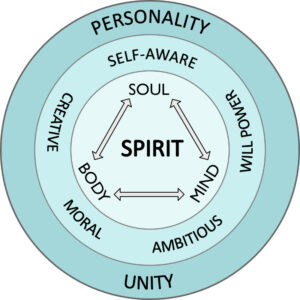
Personality functions as a system that is more than the sum of its components; it is more than a collection of behavioral traits and physical qualities. Imagine the personality as an encompassing, living matrix in which body, mind, and soul are integrated components in a unified system.
While this unique matrix never changes in and of itself, it serves to articulate and unify the constituent parts into a working and functional whole, one that changes and evolves continuously. And the product of this working system is what we perceive as human identity or character.
Another vital component of the personality matrix is the inner Spirit, which serves as our shining guide for spiritual character and behavior. This active Spirit sits at the very core of personality and is our portal to the absolute nature of God. It may not be a personal possession as such; nevertheless, it is your guiding light.
Personality is a level of deified reality.
– The Urantia Book
Personality is a creation of Deity; it is a supermaterial reality. A physical body, therefore, is not a prerequisite for personality. Humans have personalities, but so do angels and countless other types of celestial beings. And there are different orders of personality types—they are not all the same, nor do they all have the same spiritual status.
Personality Is Aware
Personality is not the intellect, but it is aware—it has a quality that allows you to be consciously aware of your own existence. It is a gift of God that endows you with an inner sense of self and a corresponding ability to be self-conscious as well as other-conscious; an awareness that other people are just as consciously aware as you are.
Personality awareness extends into the realm of superconsciousness, where you become conscious of your consciousness. Indeed, this is the true essence of mindfulness: being fully conscious of your body, your thoughts, and your soul, as well as other personalities, the universe around you, and God’s Spirit within you.
Read: Mindfulness as Spiritual Self‑Reflection
It is this sense of self and self-consciousness that allows you to say, “I exist.” This statement alone embodies a profound level of self-awareness, enabling you to see yourself. This self-awareness is an endowment that puts you far above the animal mind and further identifies you as a potential spirit being.
Personality is a distinct reality. It is not the mind because a thing cannot observe itself—the eye cannot see the eye. True enough, you can self-reflect (as in mindfulness), but it is your self that is reflecting. The very fact that you can observe your thoughts and feelings distinguishes your personality-self from your mind. Animals have no personality (as defined here); therefore, they have no ability to observe their thoughts. Instead, they are their thoughts.
Personality is perhaps what Eckhart Tolle would call the “silent watcher.” Or what Daniel J. Siegel alludes to when he states, “The mind has a mind of its own.”
The observer cannot be the thing observed; evaluation demands some degree of transcendence of the thing which is evaluated.
– The Urantia Book
While personality is not the mind, it operates within the realm of mind. Think of your personality as your self wandering among your many thoughts and feelings. It observes these thoughts and chooses, consciously or unconsciously, among them. This is the vast mental arena in which your personality functions, evaluates, and decides.
Make a conscious and clear separation between your personality and your thoughts and feelings—realize that you are a personality that has a mind. This empowering knowledge helps you to objectify your thoughts and feelings, thereby making your mind something you control rather than letting it control you.
Unique Attributes of Personality
Personality discriminates by its moral awareness—the ability to choose how to conduct oneself in any situation. Moral awareness, or moral insight, enables us to evaluate and choose between different goals as well as the means needed to reach them. In particular, your personality distinguishes spiritual and altruistic goals over and above animalistic or selfish ones.
A moral being… knows what he is doing, why he is doing it, where he is going, and how he will get there.
– The Urantia Book
Read: Morality, Magic, and Sacrifice
Personality has the innate ability to communicate with other personalities as well as to understand, sympathize, and love. True enough, animals can communicate to a limited degree within their own species, but they cannot share philosophical ideas or inner experiences as humans can. It is the intelligent and communicative aspect of personality that allows us to contact spirit—even the Spirit Source of all reality.
Personality is ambitious. Embodied within this matrix of identity is the spiritual desire to master the physical universe through the mediation of mind. Without this innate drive, there would be no scientific innovation, no philosophical pursuit, no religious quest, nor any progress in civilization or its institutions.
Personality is creative. The physical brain structures and memory patterns of animals and humans are similar, but only humans have the ability to associate and recombine facts, ideas, and relationships to discover new facts, new ideas, and new relationships. It is this creative and exploratory capacity that leads to art, invention, philosophy, and ethics.
Personality is not time-constrained—it is aware of past, present, and future. Animals do not regret or appreciate past or future events. The animal mind may think and have feelings, but it is only aware of the immediate objective world, whereas human consciousness is aware of both the objective and subjective worlds, past, present, and future. Only personalities can decide what they will do before they do it.
Your Spirit Guide is the spirit nucleus of your personality. And when you allow it to govern your heart, you begin to identify with that Spirit—to become spiritual in nature. Personality, when willingly unified with spirit, fosters spiritual insights, meaningful experiences, real achievements, and a sense of adventure—it is your individual, unique self on an ongoing, progressive spiritual journey.
Spirit is the fundamental reality of the personality experience of all creatures because God is spirit.
– The Urantia Book
Your Connection with God
When we try to understand ourselves and to grasp the meaning of life, nothing helps us more than the simple realization that we are indeed spiritual children of a spiritual Father. This is an essential attitude of mind because it is a profound acknowledgment of truth that opens the door to heightened spiritual insight.
We reinforce the truth of this relationship whenever we ponder our spiritual possessions, such as personality, mind, and soul, as well as the fact that our souls are the creation of a joint venture with God. All of this points to the spiritual truth that we are indeed creatures of a Creator God.
See Your Soul – What Is It? and Your Mind – Make It Spiritually Receptive
God is the Divine Parent of all freewill beings. And anyone who has been a parent or can identify with the love and care of children is keenly aware of the depth and scope of this unselfish, unconditional love. It is a divine love we can easily cherish.
In an ideal world, a child doesn’t need to do anything to make their parents love them. Similarly, we do not have to do anything to make God love us since his love shines on all of us at every moment. True, we can destroy ourselves by our own choices, and we can reject his infinite love if we so wish, as any child can. But it is always there whenever we are ready and willing to receive it.
For those who are led by the Spirit of God, are the children of God.
– Paul of Tarsus
Prepare yourself for a spiritual experience unlike any other when you wholeheartedly come to believe that you are, in truth, a spiritual child of a Spirit Creator. It is a truth that will transform you, bringing you peace of mind and inner happiness. Indeed, the first step in your divine journey is to imagine, accept, and believe this truth. It is an essential belief that leads you to the very gateway of an amazing and eternal spiritual adventure.
By accepting that you are a spiritual child of God, you come to understand the true nature of your relationship with such a magnificent and almighty Power. Only the trusting and humble can ever hope to approach the infinite, eternal, and majestic presence of the Universal Father.
Truly I tell you, unless you change and become like little children, you will never enter the kingdom of heaven.
– Jesus of Nazareth
When Jesus tells us to become like little children so that we may enter the spiritual realm, he’s not suggesting we should be childish in our approach to spirituality, but rather that we humbly recognize and accept our true parent-child relationship with God. It is a relationship of love and understanding, one that combines an adult’s resolute courage and determination with a child’s wholehearted faith and trust in the goodness and wisdom of a Divine Parent.